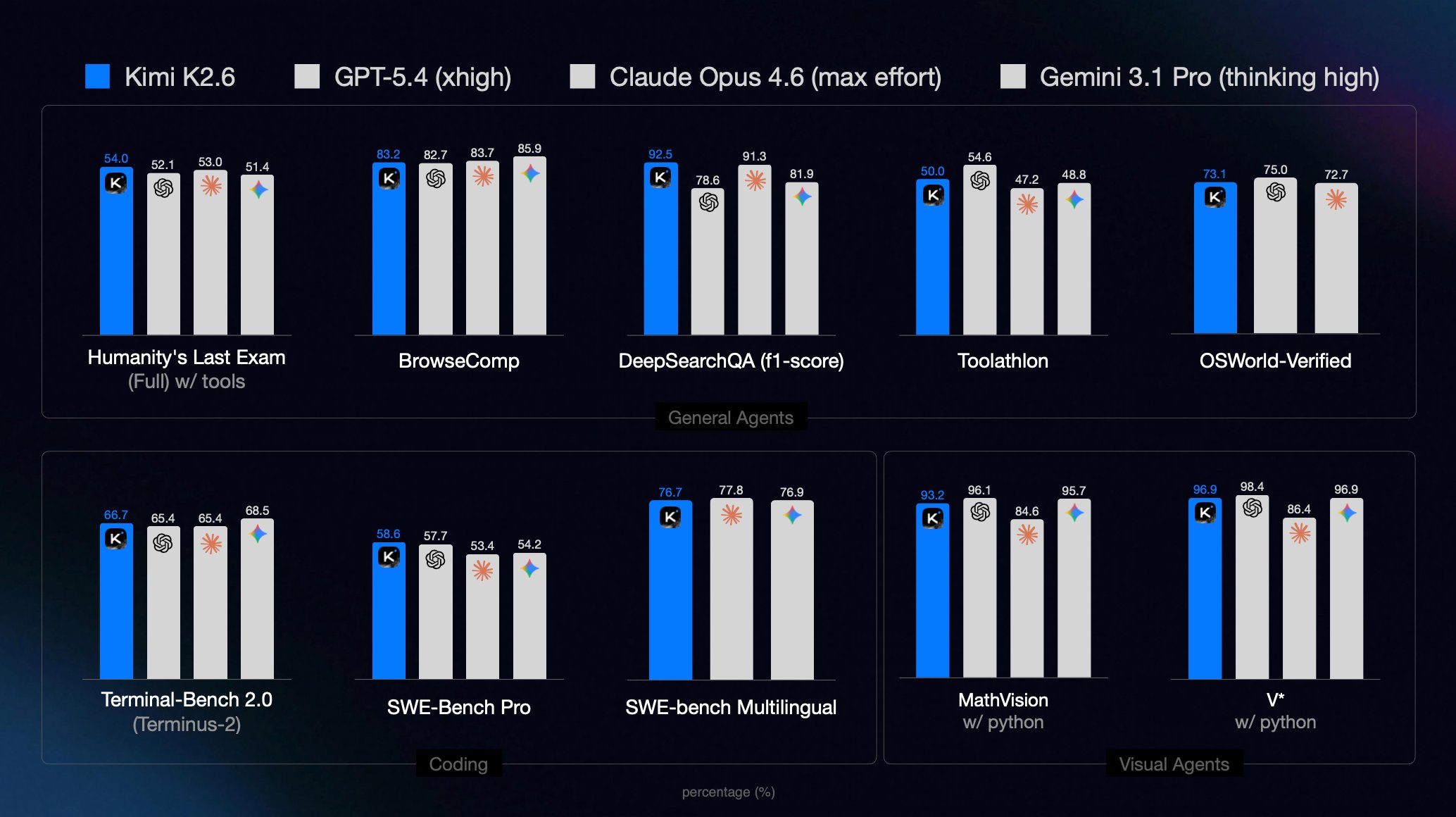
Kimi K2.6 — released by Moonshot AI on April 19, 2026 — is now a supported LLM provider in Ship Safe. One env var and you're running all 29 security agents on Kimi's infrastructure.
Why Kimi K2.6 matters for security scanning
Tool-use accuracy is the metric that matters for agentic code analysis. A model that drops tool calls or hallucinates arguments produces false negatives — security issues that get missed because the agent lost its way mid-chain.
Kimi K2.6 benchmarks at 96.6% tool invocation success rate on ACEBench. For context, that benchmark specifically measures whether a model calls the right tool with the right arguments across multi-step agent tasks — exactly what Ship Safe does when it dispatches 29 agents across your codebase.
The other relevant number: 300 parallel sub-agents with 4,000+ tool calls per session. Ship Safe's orchestrator already runs agents in chunks of 6 — Kimi's ceiling means that constraint is about infrastructure cost, not model capacity.
Pricing for deep analysis
| Tier | Input | Output |
|---|---|---|
| Long context | $0.95 / MTok | $4.00 / MTok |
| Short context | $0.15 / MTok | $0.60 / MTok |
A full npx ship-safe audit . on a mid-size codebase (100 files, ~50K tokens of context) with Kimi K2.6 costs roughly $0.05–0.15 per scan. That makes it practical to run on every PR, not just as a periodic manual step.
How to use it
Set your Moonshot API key and pass the provider flag:
export MOONSHOT_API_KEY=sk-...
npx ship-safe audit . --provider kimi
Or add it to your project .env and Ship Safe will auto-detect it:
MOONSHOT_API_KEY=sk-...npx ship-safe audit .Both kimi and moonshot are valid as the --provider value. The default model is kimi-k2.6. You can override it with --model kimi-k2.5 if you're on an older tier or want to compare outputs.
What changes in practice
Nothing in the audit pipeline changes — all 29 agents run the same rules regardless of provider. The provider only affects the deep analysis phase: when agents have collected raw findings and need to classify them as real vs. false positive and generate fix suggestions.
With Anthropic (the default), that phase uses claude-haiku-4-5 for speed and claude-sonnet-4-6 for complex findings. With Kimi K2.6, the same routing runs through Moonshot's API at roughly 60% lower cost per token.
If you've been avoiding deep analysis on large codebases because of API cost, Kimi K2.6 removes that barrier.
Other supported providers
Ship Safe supports any OpenAI-compatible endpoint. Current presets: anthropic, openai, google, groq, together, mistral, deepseek, xai, kimi, ollama, and gemma4 (local). Pass any custom endpoint with --base-url.
See the GitHub README for the full provider reference.
FAQ
How do I run Ship Safe with Kimi?
Set the provider environment variable described above. All 29 security agents then run against Kimi's infrastructure — no other change to your workflow.
Why choose Kimi for security scanning?
Cost at depth. Security scanning is a long-context, high-volume workload, and per-token price determines how much analysis is practical rather than affordable-in-theory. The pricing section above has the comparison.
Does Ship Safe require an LLM provider at all?
No. The deterministic scan runs offline with no API key and remains the authoritative result. A provider adds semantic analysis on top of it.